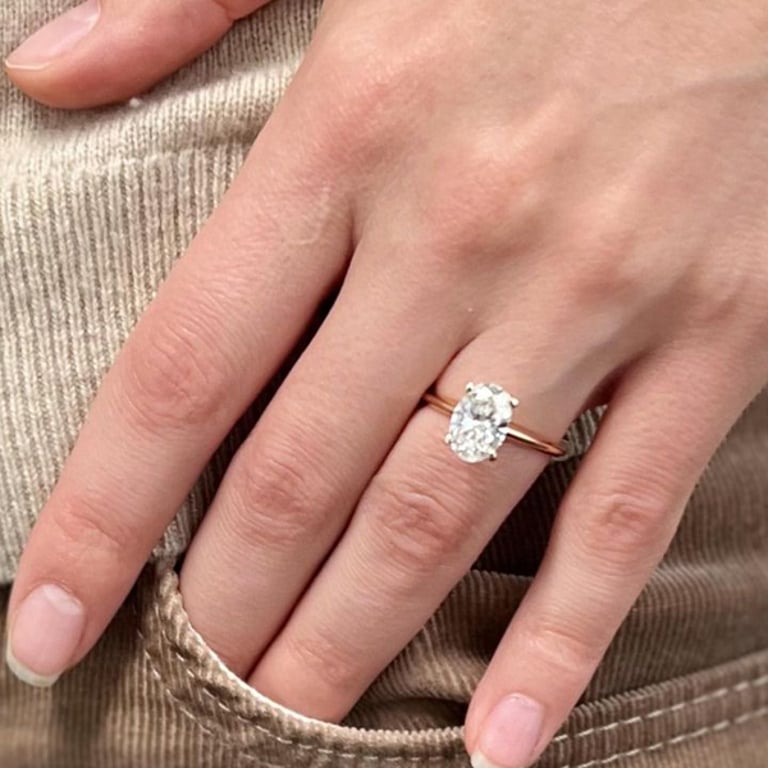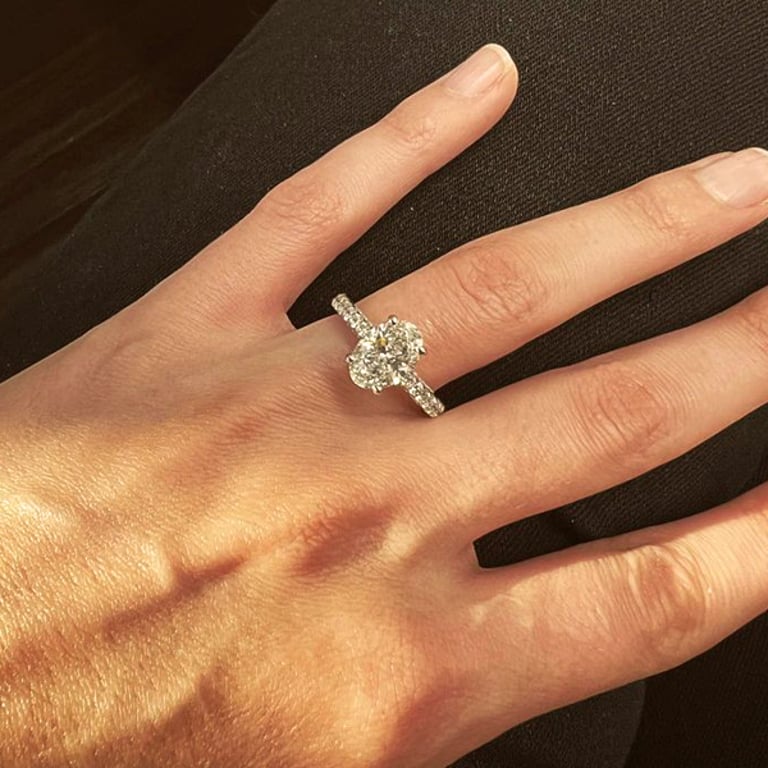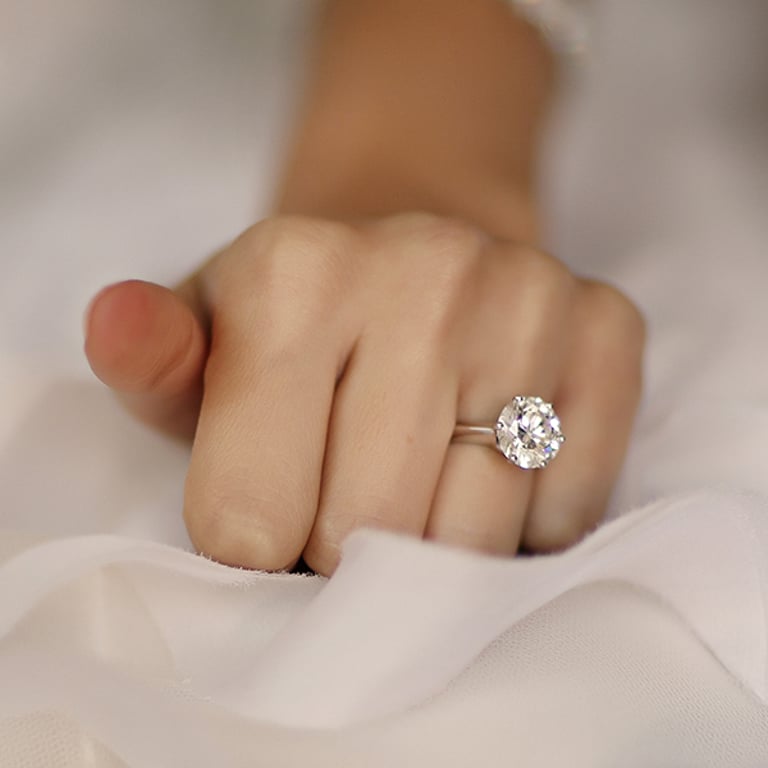
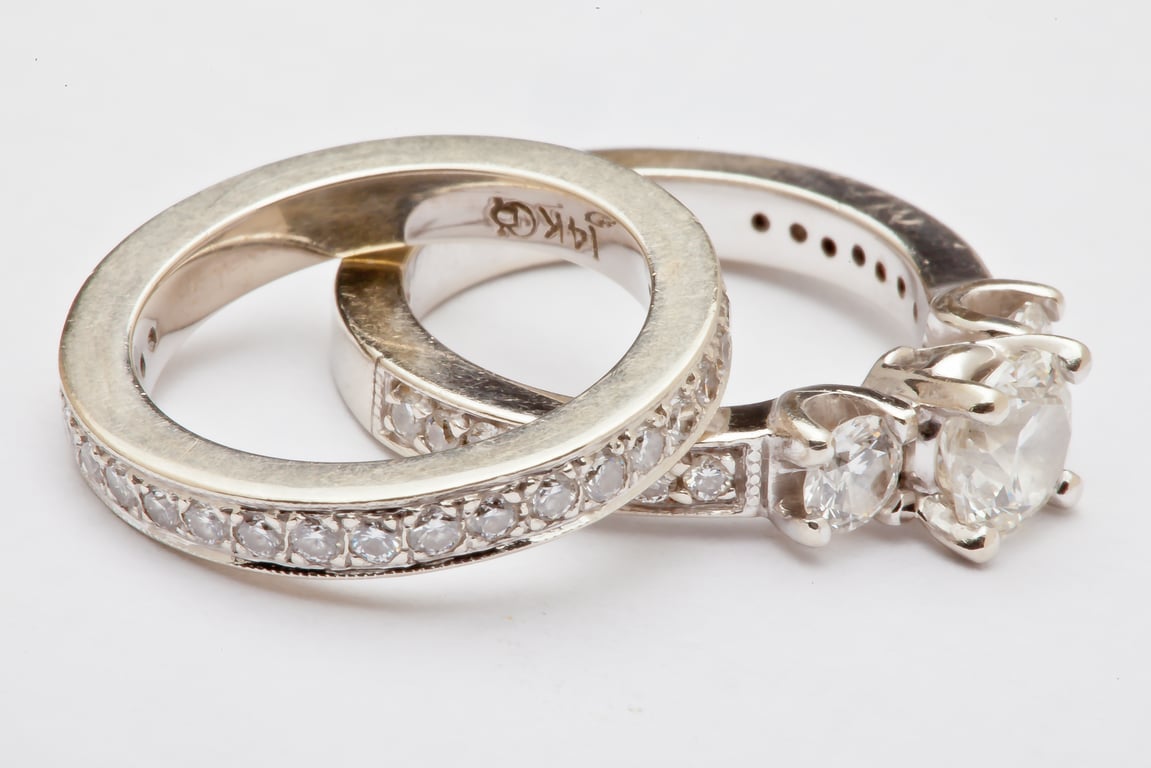

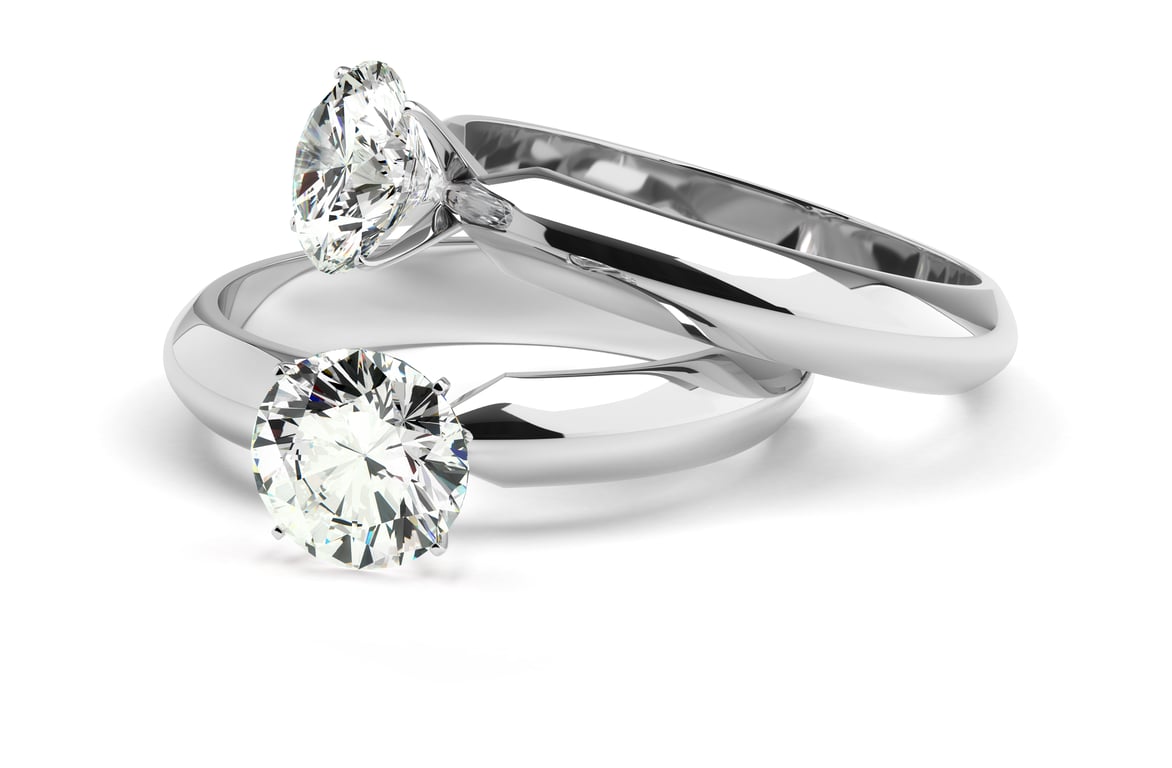
Matching your wedding ring with your engagement ring may be trickier than you might think. Apart from the visual aspect of it, both rings have to fit together in terms of practicality and comfort. Such factors as the tone of metal, ring width, design, and profile will play an essential role in achieving the desired result.
In this guide, we will find out how to select a wedding ring for your engagement ring and how to make it match harmonically. We will discuss such aspects of selection as metal type, style, and design. You will learn about yellow gold, white gold, rose gold, and platinum, as well as different kinds of wedding bands.
How to Choose the Right Metal for Your Rings
Matching wedding band and engagement ring is not only about choosing the rings made of the same metal type. The main thing here is the harmony of style, color, proportions and design. If two rings match each other, then a set of rings will look like a deliberate combination, and will express the style of their owner at the same time.
The rings do not need to be made of the same metal. Platinum and white gold, white gold and yellow gold or even mix of rose, yellow and white gold will provide the couple with elegance and uniqueness. Similar metals will give the classic uniform look, but different metals will give special characteristics to the ring set and make it modern. Modern jewelry trends also tend to favor mixed metals in ring sets.
It is also necessary to consider the shape, width, setting, and profile of both rings. The contour or curve wedding band will be the best choice if the engagement ring has a big or low center stone, and a classic straight ring can complement a solitaire perfectly. Good combination of rings will not only look beautiful, but also will be comfortable to wear.
There is also an interesting historical data about matching rings. According to The Knot's 2017 Jewelry & Engagement Study, 24% of couples bought a wedding band that matches the engagement ring, and 90% bought nonmatching wedding bands. It is clear that exactly the same style or metal type is not necessary. Nowadays, the emphasis is made on the coordinated look.
So, there is no need to be afraid of any experiments and choose whatever rings look perfect. It is possible to choose the rings made of the same metals for the classical look, or to play with the combination of metals and styles and to create a more modern look.
Complementary Styles
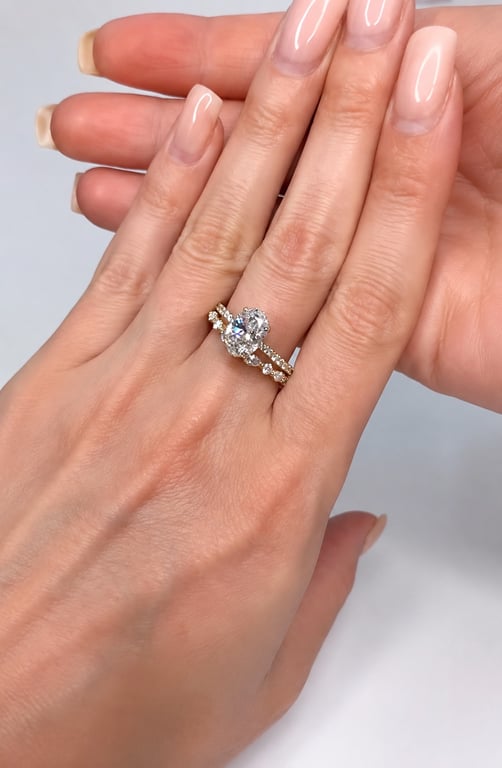
There are numerous options to choose from both for an engagement ring and a wedding band, and it may not always be a good idea if these two rings are similar in their look. The main aim here is to find out the combination in which these two types of jewelry are perfectly balanced by shapes, proportions, metals, stones, and designs used.
Statistics from modern times also point to diversity in the selection of engagement rings. As a result, the data collected in the study of The Knot's Real Weddings in 2026 shows that 38% of engagement rings have been set in solitaire and 83% of engagement rings feature a clear diamond while 61% have the center diamond created in the lab. Three primary criteria considered for selecting an engagement ring are cut/shape, style/setting, and metal.
It is also important to take into account the selection of a wedding band considering the engagement ring's design and combination of both rings.
Practical Comparison of Popular Engagement Ring Styles and Wedding Bands
| Engagement Ring Style | Recommended Wedding Ring Style | Why They Work Together |
| Solitaire Engagement Ring | Classic, Pave, Eternity, Stackable | Adds detail without overpowering the center stone. |
| Side-Stone Engagement Ring | Classic, Pave, Tapered, Curved | Keeps the focus on the center and side stones. |
| Pave Engagement Ring | Plain, Slim Pave, Eternity | Creates balance or adds extra sparkle. |
| Three-Stone Engagement Ring | Classic, Slim Pave, Tapered | Balances the additional stones. |
| Halo Engagement Ring | Plain, Slim Pave, Curved/Contour | Complements the halo without competing with it. |
| Vintage Engagement Ring | Vintage, Milgrain, Engraved, Curved | Creates a cohesive vintage look. |
| Unique Engagement Ring | Minimalist, Custom, Curved | Keeps the unique engagement ring as the focal point. |
| Custom Engagement Ring | Custom, Matching, Curved, Stackable | Provides the best fit and visual harmony. |
Do not forget that the compatibility of these two rings is important but it does not mean that they must be similar. Some features like metals, textures, width, and design may match if used reasonably. For example, the white gold engagement ring can match with the yellow gold wedding ring and provide you with the modern look. You may also choose the vintage engagement ring and the contemporary wedding ring to make contrast.
When choosing the combination, pay attention to both the look of the rings and their comfort. The shape of the engagement ring will define what wedding ring will suit it better. The best combination should be harmonious, comfortable to wear and reflect the style of the owner.
Pairing Suggestions wedding bands & engagement rings
A suitable wedding band for an engagement ring can be determined mostly in terms of size, shape, setting, and style preference. It is essential to choose the right shape since the visual appeal of the ring will depend on it. However, there is no rule saying that a particular engagement ring must have its own wedding band. Round stone can match any band, but elongated or angular stones may need a specially chosen design.
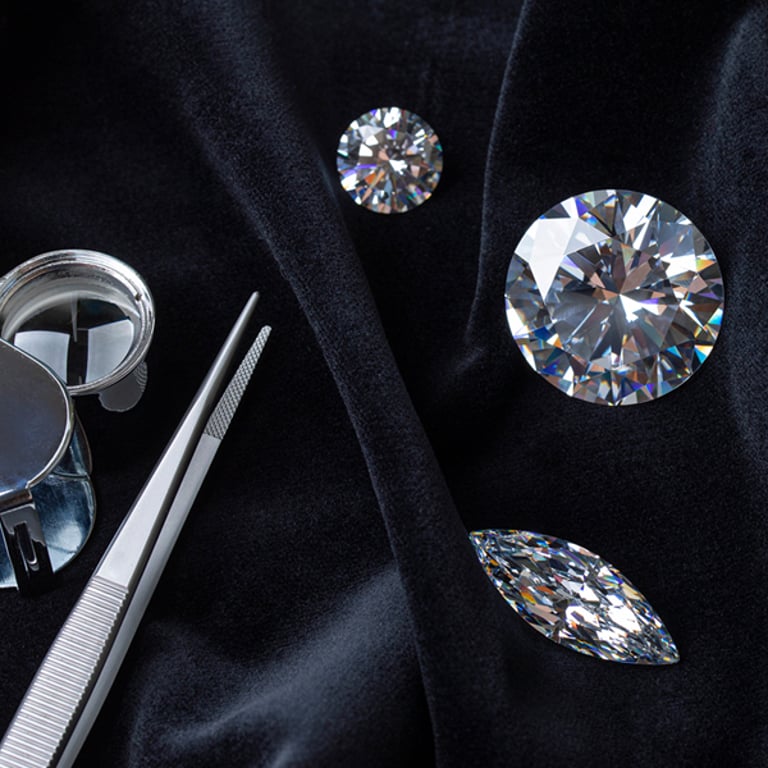
According to the recent researches, round is still the most popular engagement-ring shape with 26% of the market share, followed by oval – with 25% share. Emerald, princess, pear, and marquise shapes take 8% of engagement rings in the most recent The Knot data. Moreover, the most important engagement ring features for couples according to The Knot are cut/shape, style/setting and metal in that exact order.
The choice of a wedding band can be based on the following criteria: the height of the setting, the width of the band, the color of the metal, and the type of the band (straight, curved, pave or eternity). Contoured band will help to use a marquise or pear shaped engagement ring with a setting in which a straight band cannot fit.
Engagement Ring Shapes and Matching Wedding Bands
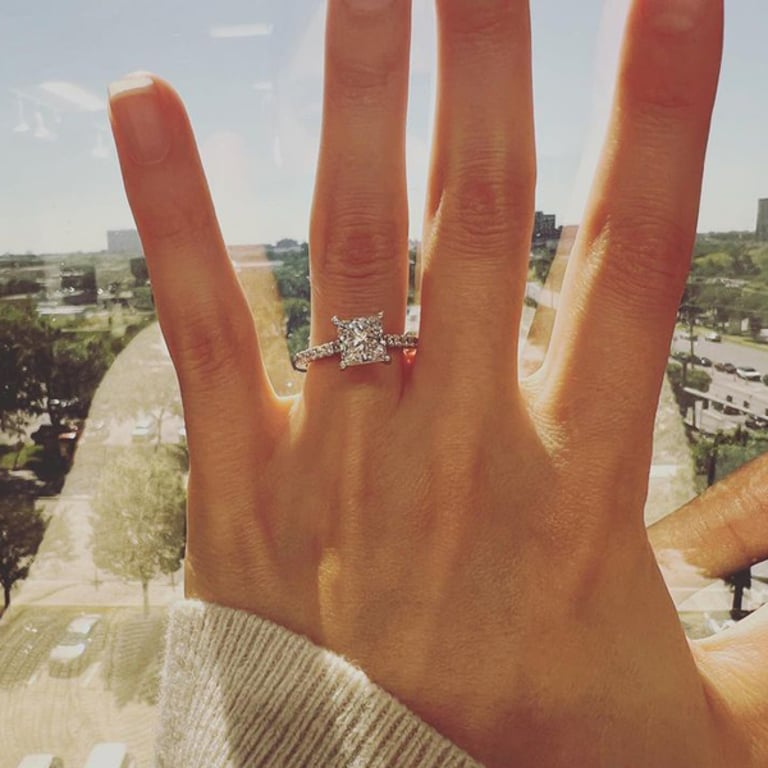
The form of engagement rings should be considered when choosing a suitable wedding band. Round and oval engagement rings can easily go with such wedding bands as a classic wedding band, a pavé band, or an eternity band, due to their perfect forms. Princess, emerald, radiant, and Asscher cut rings should be matched with those wedding bands which consist of straight lines and have shapes similar to the shapes of engagement rings.
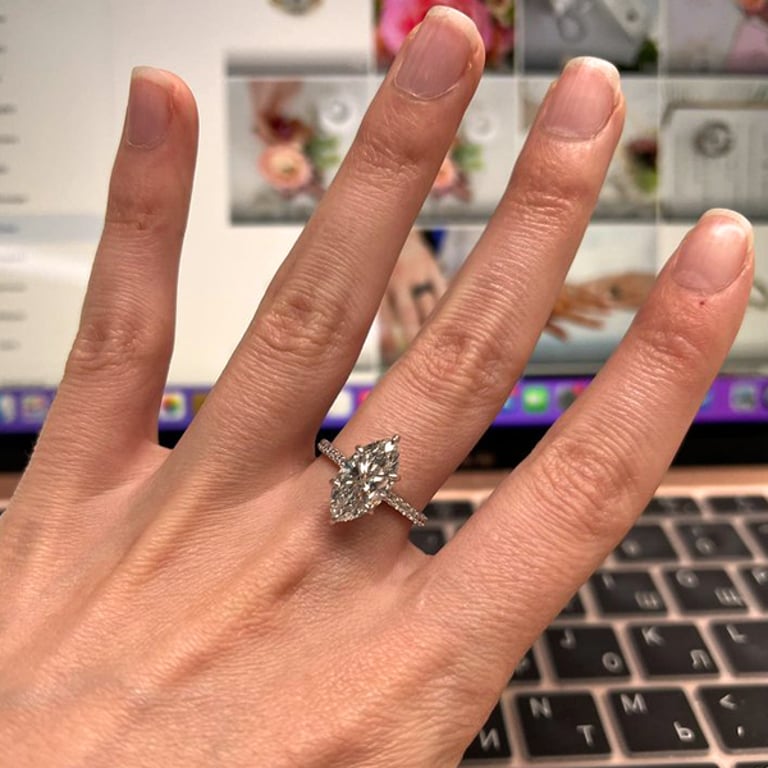
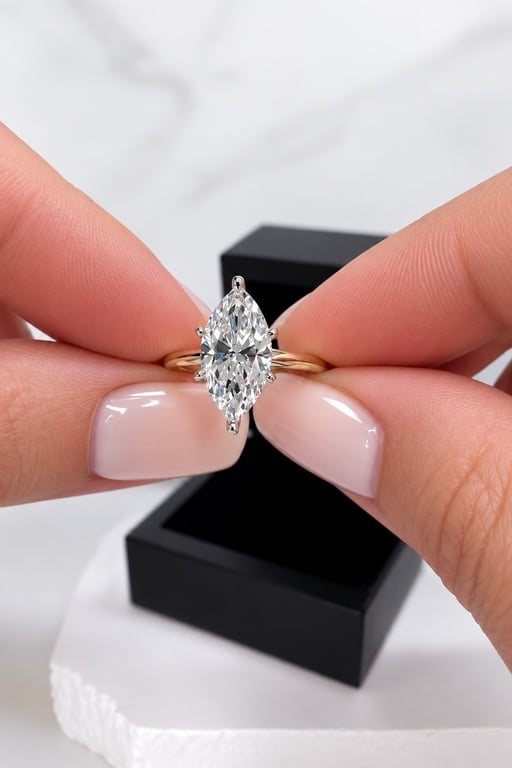
If we speak about pearl and marquise engagement rings and wedding bands, one should pay some attention to this question. The elongated form and sharp edges of the pearl and marquise engagement rings can complicate the process of matching them with wedding bands. However, there are curved wedding bands which perfectly fit the form of pearl and marquise engagement rings.
| Engagement Ring Shape | Recommended Wedding Band | Why They Work Together |
| Round | Classic, Pave, Eternity, Stackable | Works well with almost any band. |
| Oval | Pave, Eternity, Curved, Classic | Complements the elongated shape. |
| Princess | Straight, Pave, Channel, Eternity | Matches its clean geometric lines. |
| Cushion | Pave, Vintage, Milgrain, Curved | Enhances its soft, romantic shape. |
| Emerald | Classic, Pave, Baguette, Channel | Complements its elegant straight lines. |
| Pear | Curved, Contoured, Pave, Classic | Balances the pointed shape. |
| Marquise | Contoured, Curved, Pave, Classic | Frames the elongated silhouette. |
| Radiant | Pave, Channel, Eternity, Straight | Works well with structured designs. |
| Asscher | Channel, Baguette, Eternity, Classic | Complements its geometric Art Deco style. |
* You can shop wedding rings and shop engagement rings in our collection to compare different styles and find the right option for your budget.
Wedding Band Styles That Complement an Engagement Ring
Selecting the appropriate wedding ring is not only about ensuring that the two match in terms of material and the shape of the gemstone. The structure and silhouette of the band can also help you determine whether it complements the engagement ring. There are rings designed to accentuate the form of the engagement ring, as well as those that provide extra glitter. The following are four popular choices.
Enhancer and Wrap Rings
Enhancer and wrap rings are meant to encircle the engagement ring to create the illusion of a set piece. While wedding bands traditionally just sit side-by-side with engagement rings, they can also encircle and embrace the engagement ring by including additional gems. The design of such rings proves useful in the event of a desire to bulk up a solitaire or halo engagement ring. In addition, the enhancer ring comes in handy for engagement rings with irregular shapes and difficult-to-match bands.
Stackable Bands
Stacking wedding rings provide the benefit of enabling more than one ring to be worn at once along with an engagement ring. This can be done using identical metals to match them or using different combinations of metals and gemstone settings. The stackable wedding rings are popular among those individuals who wish to customize their ring ensemble as they grow older in life. More rings may be added in the form of a celebration.
Contoured and Shaped Bands
Contoured and sculptured wedding rings are made in such a way that the ring contour corresponds to the contour of the engagement ring. The ring may either follow the outline of the gemstone or the outline of the setting, thus fitting together perfectly with the other ring. It is ideal for those engagement rings that feature gems that are pear-shaped, marquise-cut, oval, or any other type of elongated shapes as well as those that have a low-set central stone.
Notched Wedding Bands
Notched wedding bands have a small notch in the ring which helps them wrap around the center stone of the engagement ring. Such wedding bands can prove to be particularly helpful when the normal wedding band does not fit the engagement ring. Notched wedding bands can give the added clearance needed along with a traditional look. Notched wedding bands can come in handy when dealing with engagement rings that have big center stones, shallow settings, or unique designs.
Custom-Designed Wedding Bands
A custom wedding band is one of the best solutions in case you need a wedding ring that will perfectly coordinate with your engagement ring. Rather than looking for an already existing wedding ring which would suit the engagement ring, you will get an opportunity to discuss your engagement ring's metal type, stone shape, setting height, ring width, profile, and design with the jeweler and get the wedding band specifically made to match it in appearance and wearability.
Moreover, you get more freedom in choosing the design of your wedding band. The jeweler can tell you which type of metal – platinum, white, yellow or rose gold – will best harmonize with your engagement ring and which kind of wedding band – straight, curved, contoured, notched or diamond-set – should be chosen to match the engagement ring. Besides, the custom design process will allow you to order both engagement ring and wedding band as an ensemble of uniquely matching rings.
However, the greatest drawback of such a solution is its price. Additional design, consultations, CAD drawings, fittings, and finishing are required for the custom jewelry making. The current pricing guide puts most of custom engagement rings at $2,000-$8,000 range, and custom wedding bands at $1,200-$4,500. More complicated and luxurious platinum wedding bands with diamonds, engraving or full custom design can cost $7,500-$8,000+.
The price of the jewelry depends mostly on the center stone choice, type of metal, amount of diamonds, complexity of the design and amount of handcrafting. The price of a custom jewelry piece will be significantly affected by the center stone you choose – for instance, a custom 1-carat design will cost $4,304 in case of moissanite, $6,828 for lab-grown diamond and $9,755 for diamond.